Product Guide | Updated: May 08, 2026 | Reading time: ~7 min
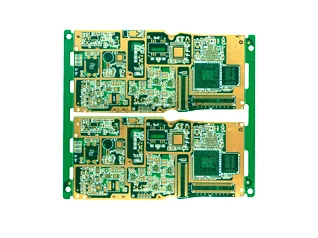
10-layer HDI three-tier PCB
10-layer HDI three-tier PCB is a flexible printed circuit board (FPC) manufactured by Well Circuits in our ISO 9001-certified facility. The board is designed for engineers and procurement managers who need a reliable, specification-driven product for flexible, miniaturized consumer and automotive applications. This guide covers key specifications, material options, quality standards, and ordering requirements. All builds comply with IPC — Institute for Printed Circuits IPC standards; specify Class 2 or Class 3 at order.
Unlike rigid boards, flexible PCBs are built on polyimide (PI) or polyester (PET) substrates that can bend, fold, and twist during assembly or end-use. The material choice directly affects three performance dimensions: minimum bend radius, thermal resistance, and dynamic flex life. Choosing the wrong substrate specification — even by a small margin — results in cracked traces or delamination in production or field use. This section explains how to specify the right material for your application.
Coverlay vs. Solder Mask: Which to Choose
Coverlay film is polyimide film laminated over the outer copper traces with adhesive. It provides superior chemical resistance, flexibility, and electrical insulation — essential for dynamic flex applications (folding connectors, hinge areas). Liquid photoimageable (LPI) solder mask offers finer feature resolution and lower cost but is less flexible and more prone to cracking at tight bend radii. For static flex (one-time folding during assembly), LPI is usually sufficient. For dynamic flex (continuous motion in end-use), coverlay is required.
This product is engineered for design teams and procurement managers working on next-generation electronic products where board performance, reliability, or space constraints are critical. The following verticals represent the most common applications — if your use case is not listed, contact our engineering team.
- Consumer electronics — smartphones, tablets, wearable devices, TWS earbuds where performance and miniaturization are non-negotiable
- Automotive electronics — dashboards, ADAS sensors, EV power management boards requiring thermal cycling reliability (-40°C to +125°C) per AEC-Q100/AEC-Q200
- Medical devices — portable diagnostic equipment, implantable device prototypes meeting ISO 13485 quality system requirements
- Industrial IoT — environmental monitoring nodes, motor control boards, IoT hardware operating in high-vibration environments
- Aerospace and defense — avionics, satellite communications, UAV flight control systems requiring extended temperature range and vibration resistance
What files do I need to provide for a quote?
Provide Gerber files (RS-274X or Gerber X2 format, preferred), drill file (Excellon format), and a stack-up specification or layer count. If you do not have a stack-up, our engineers will design one based on your application requirements at no extra charge. For controlled impedance boards, include impedance requirements per signal net.
Can I get IPC Class 3 certification?
Yes. Specify IPC Class 3 at order placement. We perform micro-section analysis on a representative sample from each production panel and include the micrograph report with your shipment. Additional charges apply for Class 3 inspection and documentation. Class 3 is required for aerospace, defense, and medical implant applications per IPC — Institute for Printed Circuits IPC-A-600 and IPC-6012 standards.
What is your minimum order quantity (MOQ)?
We accept orders from 5 pieces for standard prototypes. Volume pricing starts at 50 pieces; mass production pricing at 100+ pieces. There is no MOQ for standard samples — even a quantity of 1 is accepted for prototype builds (at standard sample pricing). For HDI and rigid-flex boards, the minimum quantity is typically 5 pieces due to the fixed tooling cost per panel.
Do you handle PCB assembly (PCBA)?
Yes. We offer full turnkey PCB assembly with component sourcing from our global distributor network (Digi-Key, Mouser, Arrow). We also support consigned assembly if you prefer to supply your own components. For flex boards, our assembly engineers review thermal profiles for reflow compatibility — especially important for flexible boards that may require hold-down fixtures during assembly.
How do you handle quality disputes?
We review all defect claims within 24 hours of receipt. If the defect is traced to our manufacturing process, we cover full rework and return shipping at no charge. We maintain a documented defect rate log and share it with customers monthly. For boards that fail at incoming inspection due to our manufacturing errors, we follow an 8D problem-solving report within 5 working days.
Can you expedite an order?
Express service is available: 24-48 hours for simple boards (1-6 layers, standard material). 24-hour service carries a 50% expedite surcharge. 48-hour service carries a 25% expedite surcharge. Express is not available for HDI, any-layer, rigid-flex, or Class 3 builds due to their inherently longer process times. Contact our sales team before placing an express order to confirm feasibility.
What does your free DFM (Design for Manufacturability) review cover?
Our engineering team reviews every order before production begins. DFM review covers: trace/space clearances, drill aspect ratios, solder mask dams, silkscreen legibility, panelization layout, and impedance calculations (if applicable). We flag any manufacturability issues and propose corrections — at no charge. The goal is to prevent yield issues before they happen, not to reject orders. We work with you to resolve issues, not around them.