
If you’re designing a board in 2025 and still treating PCB materials as an afterthought, you’re leaving signal integrity, reliability, and money on the table.
Because the truth is: the substrate you pick—whether standard FR4, high-frequency laminates like Rogers, polyimide for flex, or metal-core for thermal performance—can make or break your design.
It affects everything:
- Your impedance control and high-speed signals
- How your board handles heat and thermal cycling
- Long-term reliability in harsh environments
- And of course… your PCB cost
In this guide, you’ll get a clear, practical breakdown of the most important PCB material types, what their dielectric constant (Dk) and dissipation factor (Df) actually mean for you, when you should move beyond standard FR4, and how to choose the right stackup for applications like 5G, automotive, power electronics, and flex/rigid-flex.
If you’ve ever wondered “Should I stay with FR4 or jump to Rogers or polyimide?”—this is where you’ll get a straight answer.
What Are PCB Materials?
When I talk about PCB materials, I’m really talking about everything that makes up the printed circuit board stack: the substrate, laminates, copper, and surface finishes that let your design actually work in the real world.
PCB Substrates and Laminates Explained
A PCB substrate is the base insulating material that supports the copper traces. It’s usually a rigid or flexible dielectric sheet like FR4 substrate, polyimide, PTFE Teflon, or ceramic PCB material.
A PCB laminate is made when we bond copper foil to this substrate under heat and pressure. In production, I use a mix of:
- Core laminate – substrate with copper on one or both sides
- Prepreg – partially cured resin that bonds layers together in multilayer PCBs
Together, these form the PCB board materials that define signal behavior, reliability, and cost.
Core PCB Material Components
Every PCB, from single-sided to complex multilayer, is built from a few key PCB dielectric materials and metals:
- Dielectric base – FR4, Rogers laminate, Taconic materials, polyimide, metal core, or ceramic
- Copper foil – forms traces, planes, pads, and high-current paths
- Prepreg layers – glass fabric plus resin for bonding and insulation in multilayer PCB materials
- Surface layers – solder mask, silkscreen, and finishes like ENIG, HASL, or immersion silver
How we combine these PCB laminate materials is what you see as the final PCB stackup design.
Impact on Single-Sided, Double-Sided, and Multilayer Boards
The type of PCB materials used directly affects how far you can push your design:
- Single-sided PCBs
- One copper layer on a cheap substrate like FR4 or CEM-1
- Used for low-cost consumer and appliance boards
- Double-sided PCBs
- Copper on both sides of an FR4 PCB material or similar substrate
- Vias connect layers, allowing denser routing and better grounding
- Multilayer PCBs
- Alternating copper, prepreg, and core laminates (4, 6, 8+ layers)
- Let me build controlled-impedance, high-speed, and RF microwave PCB materials stackups
- Choice of FR4, high frequency PCB materials (Rogers, PTFE), or metal core PCB sets performance, especially for 5G, automotive, and aerospace PCB materials
In short, PCB materials are made up of the dielectric base, copper, and bonding films, and the way I choose and stack them determines signal integrity, heat management, mechanical strength, and total PCB cost.
Key Properties of PCB Materials
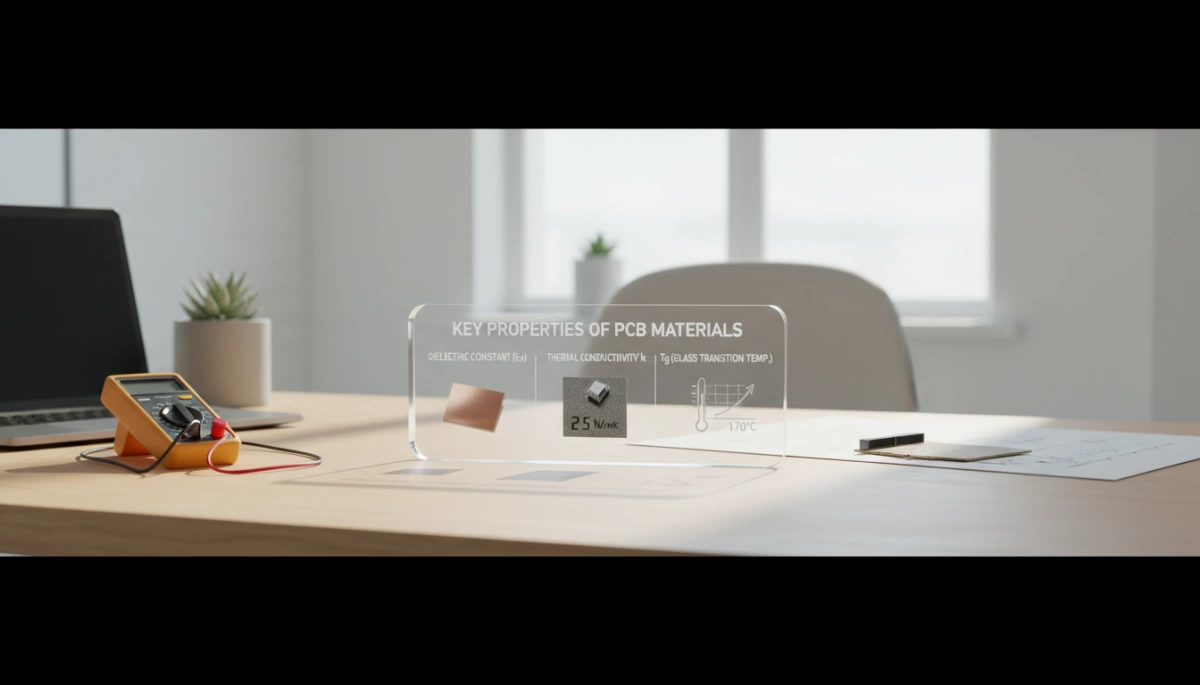
When I choose PCB materials for production, I always look at four main property buckets: electrical, thermal, mechanical, and safety/compliance. If any of these are off, the board won’t perform well or won’t pass U.S. customer and regulatory requirements.
Electrical Properties of PCB Materials
For high‑speed, RF, and 5G work, electrical specs make or break the design:
- Dielectric constant (Dk)
- Controls signal speed and impedance.
- Lower and stable Dk (like many Rogers laminates or PTFE Teflon PCB materials) helps with cleaner high‑frequency routing.
- Dissipation factor (Df)
- Directly affects signal loss.
- Lower Df = less loss = better signal integrity on long traces and fast edges.
- Signal integrity
- Dk and Df together impact ringing, crosstalk, and eye diagrams.
- For high frequency PCB materials (5G, radar, RF microwave PCB materials), I favor low‑loss PCB laminates vs standard FR4 substrate.
Thermal Properties of PCB Materials
U.S. customers in automotive, power, and industrial care a lot about heat:
- Glass transition temperature (Tg)
- Above Tg, the PCB softens and can warp.
- High Tg FR4 and high temperature PCB materials are a must for automotive PCB materials and some aerospace PCB materials.
- Thermal conductivity
- Higher thermal conductivity helps pull heat away from hot components.
- Metal core PCB (aluminum or copper base) wins here vs standard FR4.
- Coefficient of thermal expansion (CTE)
- A stable PCB CTE keeps vias and solder joints from cracking during thermal cycling.
- Decomposition temperature (Td)
- Td shows when the resin starts to break down.
- Lead free PCB materials need higher Td to survive RoHS reflow profiles.
Mechanical Properties of PCB Materials
For U.S. users in wearables, automotive, and harsh environments, reliability is key:
- Strength and rigidity
- Standard FR4 PCB materials work for most consumer products.
- CEM laminates are lower cost, but not as strong or robust.
- Flexibility
- Polyimide flexible PCB and rigid flex PCB materials are better when the board must bend or fold.
- Moisture absorption
- Lower moisture uptake = better dimensional stability and more stable Dk/Df in humid environments.
Safety and Compliance for PCB Materials
To sell into the U.S. market confidently, I ensure all PCB substrate materials hit safety and environmental marks:
- Flammability rating
- Most boards we build target UL 94V‑0 flammability, meaning the material self‑extinguishes quickly.
- Environmental standards
- RoHS compliant PCB and halogen free PCB options are standard for many of our customers.
- We prioritize lead free PCB materials and eco friendly PCB materials that still meet performance needs.
Dialing in these PCB material properties—electrical, thermal, mechanical, and safety—keeps boards reliable, manufacturable, and compliant for real‑world U.S. applications.
Common PCB Materials Used Today
FR4 PCB Materials (Standard and High Tg)
For most boards I build for U.S. customers, FR4 substrate is still the workhorse.
- Standard FR4 PCB materials
- Epoxy glass laminate, good balance of cost and performance
- Typical Dk ~4.2–4.6, good for consumer and industrial electronics
- Used in laptops, power supplies, IoT, control boards
- High Tg FR4
- Higher glass transition temperature (Tg) (≥150–170°C)
- Better for lead-free PCB materials, automotive, and high-power designs
- More stable under reflow and repeated thermal cycling
High Frequency PCB Materials (Rogers, Taconic, PTFE)
When I’m dealing with RF, 5G, or radar work, standard FR4 usually isn’t enough.
- Rogers laminate (RO4000, RO3000, etc.)
- Low PCB dielectric constant variation
- Low dissipation factor (Df) for cleaner high-speed signals
- Popular for RF microwave PCB materials and 5G antenna boards
- Taconic materials
- Competitive low-loss high frequency PCB materials
- Good option for telecom, base stations, and radar designs
- PTFE Teflon PCB
- Ultra-low loss, very stable PCB dielectric materials
- Used in satellite, aerospace, and demanding RF front ends
- Higher cost and tighter processing requirements
Polyimide Flexible PCB Materials
For wearables, foldable devices, and tight assemblies, I lean on polyimide flexible PCB materials.
- Rigid flex PCB materials & flex circuits
- High temperature resistance and excellent bend performance
- Ideal for aerospace, defense, and compact consumer products
- Great where connectors and cables are risky or take too much space
Metal Core PCB Materials (Aluminum and Copper)
If thermal performance is the priority, a metal core PCB is often the right call.
- Aluminum PCB materials
- Most common metal core PCB for LED lighting and power supplies
- Good PCB thermal conductivity, affordable, easy to machine
- Copper base PCB
- Higher thermal conductivity than aluminum
- Used in very high-power or high-reliability applications
- More expensive but better for aggressive heat dissipation
Ceramic PCB Material and Specialty Substrates
For extreme reliability and harsh environments, I look at ceramic PCB materials.
- Alumina, aluminum nitride, and similar substrates
- Very high thermal conductivity and dimensional stability
- Perfect for automotive PCB materials, power modules, and PCB materials for space
- Excellent for high-voltage and high-frequency designs
CEM-1, CEM-3, and Low-Cost PCB Laminates
For simple, cost-sensitive builds, CEM laminates still make sense.
- CEM-1
- Paper/epoxy core, usually for single-sided boards
- Used in low-cost consumer and appliance boards
- CEM-3
- Glass/epoxy, whiter and smoother than FR4, easier drilling
- A middle ground between FR4 and CEM-1 on performance and price
These PCB laminate types let me match material to the job—balancing performance, heat, flexibility, and cost for U.S. customers who need reliable boards without overpaying for unnecessary specs.
PCB Material Comparison
When I pick PCB materials for US customers, I usually start by comparing FR4, Rogers, polyimide, and metal core side by side. Here’s how they stack up.
FR4 vs Rogers PCB Materials
Quick take:
- Use FR4 for general digital, consumer, and industrial boards.
- Use Rogers (and similar high frequency PCB materials like Taconic or PTFE Teflon PCB) for RF, 5G, and microwave designs.
Key comparison (typical values):
| Property | FR4 Substrate | Rogers Laminate (RF/MW) |
|---|---|---|
| PCB dielectric constant Dk | ~4.1–4.5 | ~2.2–3.5 (tighter tolerance) |
| Dissipation factor PCB Df | ~0.015–0.020+ | ~0.0009–0.004 (very low loss) |
| Glass transition temp Tg | ~130–170 °C (std/high Tg FR4) | 200 °C+ for many RF grades |
| Signal loss @ high freq | Medium–high | Very low |
| PCB material cost | Low | High |
| Main applications | General electronics, IoT, power control | 5G PCB materials, RF microwave PCB materials, radar, aerospace |
If you’re routing high‑speed or RF traces (GHz range), Rogers wins. For everyday boards, FR4 is still the king on cost and availability in the US.
FR4 vs Polyimide PCB Substrates
Quick take:
- FR4 = rigid, cost-effective, standard.
- Polyimide = flexible, high temperature, harsh environments.
| Property | FR4 PCB Materials | Polyimide Flexible PCB |
|---|---|---|
| Flexibility | Rigid only | Flexible / rigid flex PCB |
| Tg | ~130–170 °C | 200 °C+ |
| Continuous temp rating | Up to ~130 °C | 150–200 °C and above |
| Moisture absorption | Moderate | Slightly higher, but stable |
| Cost | Low | Medium–high |
| Use cases | Consumer, industrial | Automotive PCB materials, aerospace PCB materials, flex and rigid flex |
I use polyimide when the board needs to bend, fold, or live in high‑temperature conditions (under‑hood automotive, engine control, space hardware).
FR4 vs Metal Core PCB for Heat Dissipation
Quick take:
- FR4 alone struggles with high power LEDs and power stages.
- Metal core PCB (MCPCB) with aluminum or copper base is my go‑to for serious heat.
| Property | FR4 Multilayer PCB Materials | Metal Core PCB (Al/Cu base) |
|---|---|---|
| PCB thermal conductivity | ~0.3–0.5 W/m·K | 1–5+ W/m·K (depending on stackup) |
| Heat spreading | Limited | Excellent |
| PCB CTE (overall behavior) | Higher, more mismatch | Better match to power devices |
| Weight | Light | Heavier |
| Cost | Low | Medium |
| Typical applications | Logic, low–mid power | LED lighting, power supplies, motor drives |
For US LED lighting, EV chargers, and high‑power drivers, I usually spec an aluminum metal core PCB to keep junction temps under control.
PCB Material Comparison by Dk, Df, Tg, Cost, and Applications
At a glance:
| Material Type | Dk (approx) | Df (approx) | Tg (approx) | Cost Level | Best For |
|---|---|---|---|---|---|
| Standard FR4 substrate | 4.1–4.5 | 0.015–0.020+ | 130–150 °C | $ | General electronics, consumer, industrial |
| High Tg FR4 | 4.1–4.5 | 0.012–0.018 | 170–180 °C+ | $$ | Lead free PCB materials, automotive control |
| Rogers / low loss laminate | 2.2–3.5 | 0.0009–0.004 | 200 °C+ | $$$$ | High speed PCB materials, RF, 5G, radar |
| Polyimide (flex/rigid flex) | 3.2–3.6 | 0.004–0.012 | 200 °C+ | $$$ | Flexible circuits, aerospace, defense |
| Metal core PCB (Al/Cu) | 4.0–4.5 (dielectric layer) | 0.012–0.02 | 130–170 °C | $$–$$$ | Power, lighting, thermal management |
In the US market, I usually balance:
- Dk / Df for signal integrity,
- Tg and thermal conductivity for reliability,
- Cost and availability for real production runs.
That’s how I narrow down the PCB laminate types that actually make sense for each project.
Specialized PCB Materials for Demanding Applications
High Frequency & High Speed PCB Materials (5G, Radar, RF)
For high frequency PCB materials in 5G, radar, and RF designs, I focus on low loss PCB laminates with stable electrical performance:
- Rogers laminate (RO4000, RO3000 series) – low Dk drift, low dissipation factor (Df), ideal for RF/microwave PCB materials and antenna boards.
- PTFE Teflon PCB materials (Rogers, Taconic, Panasonic, etc.) – ultra‑low loss for mmWave 5G and radar.
- Hydrocarbon & ceramic-filled laminates – great balance of cost and performance vs pure PTFE.
For US customers working on 5G, radar, or high speed digital (25G/56G+), I usually recommend:
- Hybrid PCB stackup design – Rogers + FR4 substrate to cut cost.
- Tight control of PCB dielectric constant (Dk) and dissipation factor PCB values for clean signal integrity.
High Temperature PCB Materials (Automotive & Aerospace)
Automotive and aerospace PCB materials in the US market need to handle high temperature, vibration, and long life:
- High Tg FR4 (Tg ≥ 170°C) – cost‑effective for most automotive PCB materials.
- Polyimide PCB materials – true high temperature PCB materials for aerospace, defense, and space.
- Ceramic PCB material (alumina, aluminum nitride) – for extreme heat and power density.
Key specs I watch:
- Glass transition temperature (Tg)
- Decomposition temperature (Td)
- PCB CTE (coefficient of thermal expansion) to match components and avoid cracking.
Flexible & Rigid Flex PCB Materials and Stackups
For wearables, medical devices, and compact electronics in the US, flex PCB materials and rigid flex PCB materials solve tight space and weight issues:
- Polyimide flexible PCB – the most common flex substrate; thin, durable, great bend performance.
- Rigid flex PCB stackups – FR4 rigid sections + polyimide flex layers for connectors, hinges, and fold‑able zones.
When I build flex/rigid‑flex designs, I focus on:
- Bend radius and flex cycles
- Copper thickness and coverlay choices
- Reliability under vibration and temperature cycling
Lead-Free & Eco Friendly PCB Materials and Laminates
US customers are pushing hard for RoHS compliant PCB and eco friendly PCB materials without sacrificing reliability:
- Lead free PCB materials compatible with higher reflow temperatures (Pb‑free solder).
- Halogen free PCB laminates for lower toxicity and cleaner emissions.
- UL 94V‑0 flammability ratings to meet safety and building code needs.
Typical choices in my PCB materials list:
- Halogen‑free high Tg FR4
- RoHS compliant FR4 substrate and CEM laminates
- Lead‑free compatible high speed and high frequency PCB materials
All of these let us meet US regulatory requirements, corporate ESG goals, and still ship boards that perform in real‑world, high stress applications.
How to select PCB materials
1. Lock in your electrical + frequency needs
Start with the signals, not the laminate list.
- Know your max frequency / edge rate
- Up to ~1–2 GHz or standard digital: FR4 substrate is usually fine
- High‑speed / RF / 5G / radar: look at Rogers laminate, Taconic materials, or PTFE Teflon PCB
- Target dielectric constant (PCB Dk)
- FR4: ~4.1–4.6 (varies by stackup and vendor)
- High frequency PCB materials: ~2.9–3.5 for tighter impedance and lower delay
- Check dissipation factor (PCB Df)
- General digital: Df ≤ 0.02 is workable
- RF microwave PCB materials: you want low loss PCB laminate (Df < 0.005)
If you’re routing long, fast differential pairs (USB 3.x, PCIe, SERDES), PCB dielectric constant and Df matter a lot more than brand names.
2. Match thermal performance and heat
For U.S. customers building power electronics, EV, LED, or automotive boards, thermal behavior is where most designs go wrong.
Key thermal specs:
- Glass transition temperature (Tg)
- Consumer products: standard FR4 (Tg ~130–140°C)
- Lead‑free, higher temp: high Tg FR4 (Tg 150–180°C)
- Under‑hood auto, aerospace: high temperature PCB materials or polyimide
- PCB thermal conductivity
- Standard FR4: poor heat spread (~0.3 W/m·K)
- Metal core PCB (aluminum or copper base): much higher, ideal for LEDs and power stages
- Decomposition temperature (Td)
- Critical for lead‑free reflow and harsh environments
If junction temps or case temps look aggressive in simulation, you should be looking at metal core PCB materials or better copper planes, not just thicker FR4.
3. Consider mechanical + environment
Think about how the board is used in real life, not just in CAD.
- Mechanical stress / vibration
- Industrial and automotive PCB materials: favor stronger, stable FR4 PCB materials or rigid‑flex where needed
- Flexing and movement
- Wearables, foldable devices, connectors: polyimide flexible PCB, rigid flex PCB materials
- Environment
- High humidity: materials with low moisture absorption
- Outdoor or EV: stable PCB CTE (coefficient of thermal expansion) to match components and reduce cracking
For U.S. IoT and industrial gear, I usually pair standard FR4 with reinforced mounting and only move to flex PCB materials where space or motion demands it.
4. Balance cost vs performance vs manufacturability
PCB material cost comparison matters a lot once you go to volume.
Typical cost tiers (low → high):
- CEM‑1 / CEM‑3 → standard FR4 → high Tg FR4 → polyimide → Rogers laminate / PTFE Teflon PCB / advanced low loss PCB laminate
- Things that drive cost up in the U.S. market:
- Exotic PCB dielectric materials
- Very tight Dk / Df tolerance
- Thick copper or metal core PCB
- Very fine lines and dense multilayer PCB stackup design
I try to stay on FR4 as long as possible and only move up when Dk/Df or temperature data clearly says I have to.
5. Use hybrid PCB stackups for value
For many RF and high‑speed boards, a hybrid PCB stackup is the sweet spot:
- Rogers + FR4 or similar combos:
- RF layers on Rogers PCB materials or Taconic
- Power and logic on FR4 substrate
- Benefits:
- High frequency PCB materials only where they’re actually needed
- Lower cost than full‑Rogers stackups
- Easier to meet U.S. CM capability and lead times
This is standard practice for 5G PCB materials, RF front ends, and mixed‑signal designs targeting U.S. production.
6. Common PCB material mistakes to avoid
A short PCB materials checklist I use so we don’t burn time or budget:
- Using FR4 for real RF
- If you’re above a few GHz or doing serious RF microwave PCB materials, you probably need Rogers, Taconic, or PTFE.
- Ignoring Tg and Td with lead‑free
- Lead‑free PCB materials need higher Tg. Standard low‑Tg FR4 can crack, warp, or age badly.
- Over‑specing just “to be safe”
- Don’t jump to expensive ceramic PCB material or full PTFE just because it sounds “premium.” Let requirements justify the move.
- Skipping compliance
- For U.S. products, confirm UL 94V‑0 flammability, RoHS compliant PCB, and lead free PCB materials. If you’re selling to enterprise or gov, halogen free PCB can also be mandatory.
- Not checking local fab capability
- Some U.S. PCB shops don’t run every exotic stackup. Always confirm they support your chosen PCB laminate types before you lock the design.
If you line up electrical, thermal, mechanical, and compliance needs first, the right PCB materials list usually becomes obvious—and you avoid overpaying for laminate you don’t actually need.
Trends and Innovations in PCB Materials
Low Loss PCB Laminates
Low loss PCB laminates are now standard for high‑speed digital and RF in the U.S. market.
- We use low loss PCB laminate systems (advanced hydrocarbon, PTFE Teflon blends, and engineered epoxies) to cut dissipation factor (Df) and keep signal integrity clean at multi‑gigabit speeds.
- These materials are ideal for 5G PCB materials, radar, datacenter gear, and high‑speed networking where FR4 just can’t hold the line on loss and skew.
- In practice, that means tighter eye diagrams, less jitter, and fewer respins on high‑speed boards.
Halogen Free and RoHS Compliant PCB Materials
U.S. customers expect compliance by default.
- We support halogen free PCB and fully RoHS compliant PCB materials for lead free production.
- Our lead free PCB materials and laminates are tested for UL 94V-0 flammability, low toxicity, and global export compliance.
- You still get familiar systems like high Tg FR4 and advanced FR4 substrate formulations, just tuned to meet modern regulations.
Sustainable and Eco Friendly PCB Materials
Sustainability is no longer just marketing; it’s part of the design spec.
- We prioritize eco friendly PCB materials with reduced halogens, lower VOC processes, and better recyclability where the application allows it.
- For volume builds, we can recommend sustainable PCB materials that balance reliability, availability in the U.S. supply chain, and total lifecycle impact.
Impact of 5G, EVs, and Miniaturization
New applications are driving new material choices fast.
- 5G and RF microwave PCB materials: Low Dk, low Df laminates like Rogers‑class and advanced hydrocarbon systems for phased arrays, small cells, and mmWave modules.
- EV and automotive PCB materials: High temperature PCB materials with stable PCB CTE, high Tg and good thermal conductivity for inverters, on‑board chargers, and ADAS.
- Miniaturization: Thinner multilayer PCB materials, fine‑line compatible PCB laminates, and rigid flex PCB materials to pack more into tighter spaces without sacrificing reliability.
These PCB material trends directly shape how I spec stackups, quote builds, and support U.S. customers who need high speed, high reliability, and compliant boards without blowing up their material cost.
PCB Materials FAQ
Most common PCB material used in electronics
In the U.S. electronics market, FR4 PCB material is the default choice.
You’ll see FR4 substrate in everything from consumer gadgets and PCs to industrial controls because it offers:
- Good balance of cost vs performance
- Solid Tg, decent thermal conductivity, and stable dielectric constant (Dk)
- Wide supply base and easy manufacturing at any PCB shop
When in doubt for standard digital or mixed-signal boards, I start with standard or high Tg FR4.
When to choose Rogers instead of FR4
I move to Rogers laminate (or similar high frequency PCB materials like Taconic or PTFE Teflon PCB) when:
- Operating frequency is >2–3 GHz (5G, radar, RF front-ends, microwave links)
- I need tight impedance control and lower dissipation factor (Df)
- Signal integrity and low loss over distance are more critical than board cost
Use Rogers PCB materials for RF/microwave PCB designs, antennas, and high-speed RF modules where FR4 loss is unacceptable.
How PCB material selection affects total PCB cost
PCB materials heavily drive your actual project cost, not just the fab quote. Key impacts:
- Material price: Rogers, PTFE, ceramic, and metal core PCB cost more than FR4
- Layer count & stackup: Low loss PCB laminate can reduce layers or simplify the PCB stackup design
- Yield & rework: Poor material choice (wrong Tg, wrong CTE) increases scrap and field failures
- Assembly: High temperature PCB materials are needed for lead free PCB materials and RoHS solder profiles
I always compare PCB material types by Dk, Df, Tg, and CTE, then weigh that against material and manufacturing cost before locking the design.
Eco friendly and halogen free PCB material options
If your customers or compliance team in the U.S. are focused on sustainability, look at:
- Halogen free PCB laminates (often FR4 variants)
- RoHS compliant PCB and lead free PCB materials (no leaded solder or banned substances)
- UL-approved materials with UL 94V-0 flammability while still avoiding brominated flame retardants
Most major brands (Isola, Panasonic PCB materials, etc.) offer halogen-free FR4 and eco friendly PCB materials that still work with standard processes.
Best materials for high frequency and RF PCB designs
For serious RF, microwave, and 5G work, I focus on low loss PCB laminate with stable Dk:
- Rogers PCB materials (RO4000, RO3000 series) – go-to for 5G, radar, RF front-ends
- PTFE Teflon PCB and Taconic materials – very low Df, great for microwave and mmWave
- Hybrid stackups (Rogers + FR4) – RF layer on Rogers, digital and power on FR4 to cut cost
For RF microwave PCB materials, you want:
- Low and stable dielectric constant (Dk)
- Very low dissipation factor (Df)
- Good PCB thermal conductivity and controlled PCB CTE
That’s how I keep U.S. RF designs reliable while keeping PCB material costs under control.