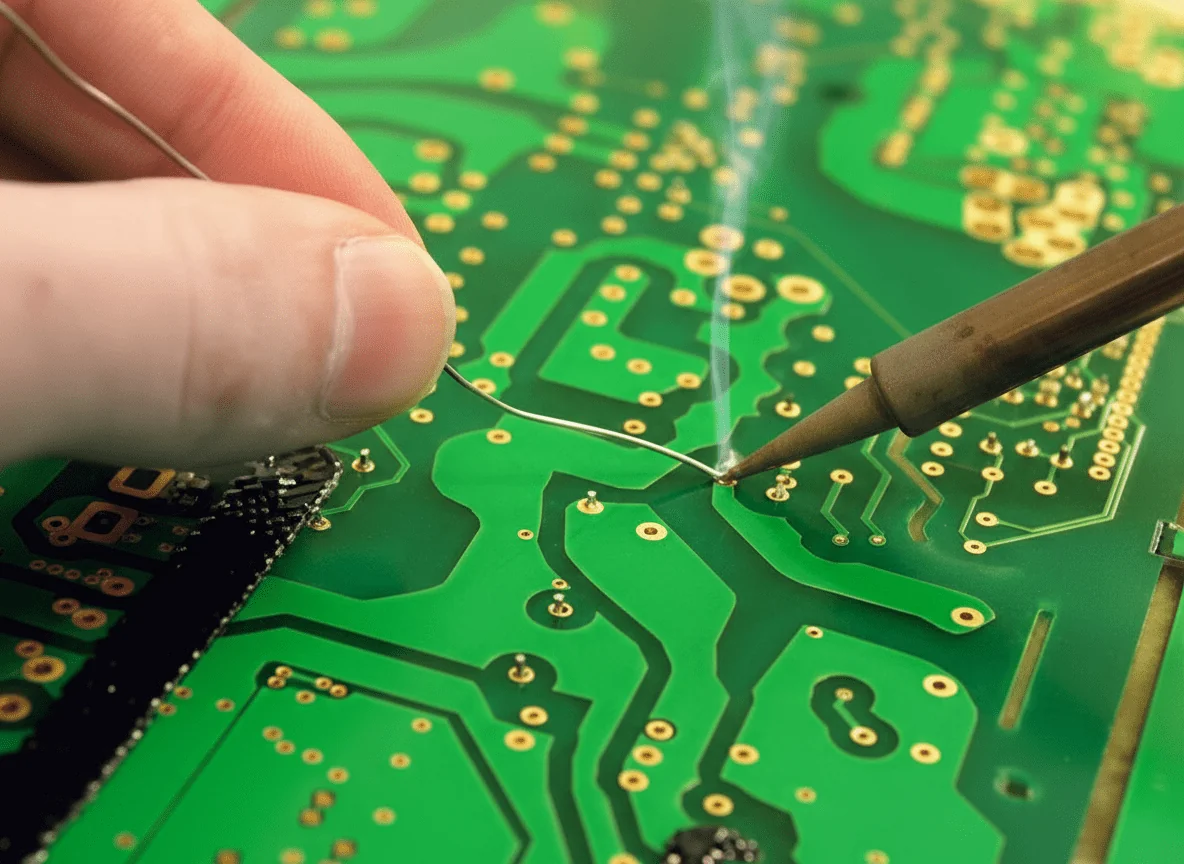

Integrated Circuits — The Tiny Titans Powering Modern Technology
In 1958, Jack Kilby fiddled with a sliver of germanium on a lab bench at Texas Instruments and changed electronics forever. His invention—the first working integrated circuit—measured smaller than your thumbnail yet contained a handful of transistors interconnected on a single piece of semiconductor material. Today, a flagship smartphone processor packs over 15 billion transistors into a chip barely larger than a fingernail. This is the story of the integrated circuit: how it works, why it matters, and where it’s headed.
What Is an Integrated Circuit?
An integrated circuit (IC) is a semiconductor wafer—typically silicon—upon which thousands to billions of transistors, resistors, capacitors, and their interconnections are fabricated through photolithography. Unlike discrete circuits built from separate components wired together on a PCB, an IC integrates all these elements into a single microscopic package. This integration enables three critical advantages: miniaturization, speed, and reliability.
Robert Noyce independently invented a practical IC at Fairchild Semiconductor around the same time as Kilby, resolving the interconnection problem that had plagued Kilby’s original design. The two companies engaged in decades of patent litigation before eventually cross-licensing their technologies—a history that shaped the entire semiconductor industry.
Types of Integrated Circuits
Digital ICs manipulate binary signals (0s and 1s) and form the backbone of computing. They include logic gates (AND, OR, NOT), flip-flops, memory chips, and microprocessors. The evolution from 8086 processors to modern x86 and ARM chips illustrates the relentless doubling of transistor density predicted by Moore’s Law.
Analog ICs process continuous signals—sound, radio waves, sensor readings. Operational amplifiers (op-amps) represent the most common analog IC family, used in everything from audio equipment to industrial control systems. Mixed-signal ICs combine digital and analog functions on the same chip, essential for data converters and system-on-chip (SoC) designs.
Memory ICs store data: DRAM for main system memory, flash for persistent storage, SRAM for caches. The explosive growth in memory density has enabled theGB-era devices we now take for granted.
How Integrated Circuits Work
A transistor acts as an electronic switch or amplifier. In a MOSFET—the dominant transistor type in modern ICs—voltage applied to the gate terminal controls current flow between source and drain. Billions of MOSFETs arranged in logic gates process binary information: add numbers, make decisions, move data.
Interconnections layer on top of transistors like a microscopic highway system. Aluminum and copper traces route signals between components. Multiple metal layers (7 to 12 in advanced chips) stack vertically, connected by via holes. This interconnect network consumes significant chip area and power.
The fabrication process creates these structures through successive masking and etching steps. A wafer undergoes photolithography—exposing light through a mask pattern—then chemical etching or deposition to build each layer. Modern processes use extreme ultraviolet (EUV) lithography with wavelengths of 13.5nm to pattern features at 5nm and beyond.
Applications Across Industries
Consumer electronics depend entirely on ICs. Your smartphone contains dozens of specialized chips: application processor, cellular modem, Wi-Fi/Bluetooth transceiver, power management, image signal processor, and memory—all integrated or packaged together.
Automotive electronics have transformed vehicles. Modern cars contain over 3,000 ICs managing engines, safety systems, infotainment, and autonomous driving features. Electric vehicles rely heavily on power management ICs and battery monitoring systems.
Industrial applications span factory automation, robotics, and IoT devices. Sensor ICs convert physical phenomena—temperature, pressure, acceleration—into digital data. Edge AI chips enable machine learning inference without cloud connectivity.
Q1: What is an integrated circuit?
A semiconductor device integrating multiple electronic components onto a single chip, enabling complex electronic functions in miniature form.
Q2: Who invented the integrated circuit?
Jack Kilby (Texas Instruments, 1958) and Robert Noyce (Fairchild Semiconductor, 1959) independently invented practical ICs.
Q3: What are the main types of ICs?
Digital ICs (logic, processors), analog ICs (amplifiers, converters), mixed-signal ICs, and memory ICs (DRAM, flash, SRAM).
Q4: How small are modern integrated circuits?
Advanced production processes reach 3nm nodes, with transistors measuring just a few dozen atoms across.
Q5: What is Moore’s Law?
Gordon Moore’s 1965 observation that transistor density doubles approximately every two years, which held remarkably true for five decades.
Q6: What is the future of IC technology?
3D stacking, chiplet architectures, and new materials (GaN, SiC) are extending performance gains as traditional scaling approaches physical limits.
Conclusion
Integrated circuits represent one of humanity’s most transformative inventions. From the first crude germanium-based designs to today’s 3nm FinFET processes, ICs have continuously shrunk while exponentially increasing in capability. The next wave—heterogeneous integration, photonic interconnects, and neuromorphic chips—promises to extend this trajectory into uncharted territory.